
Research Clusters
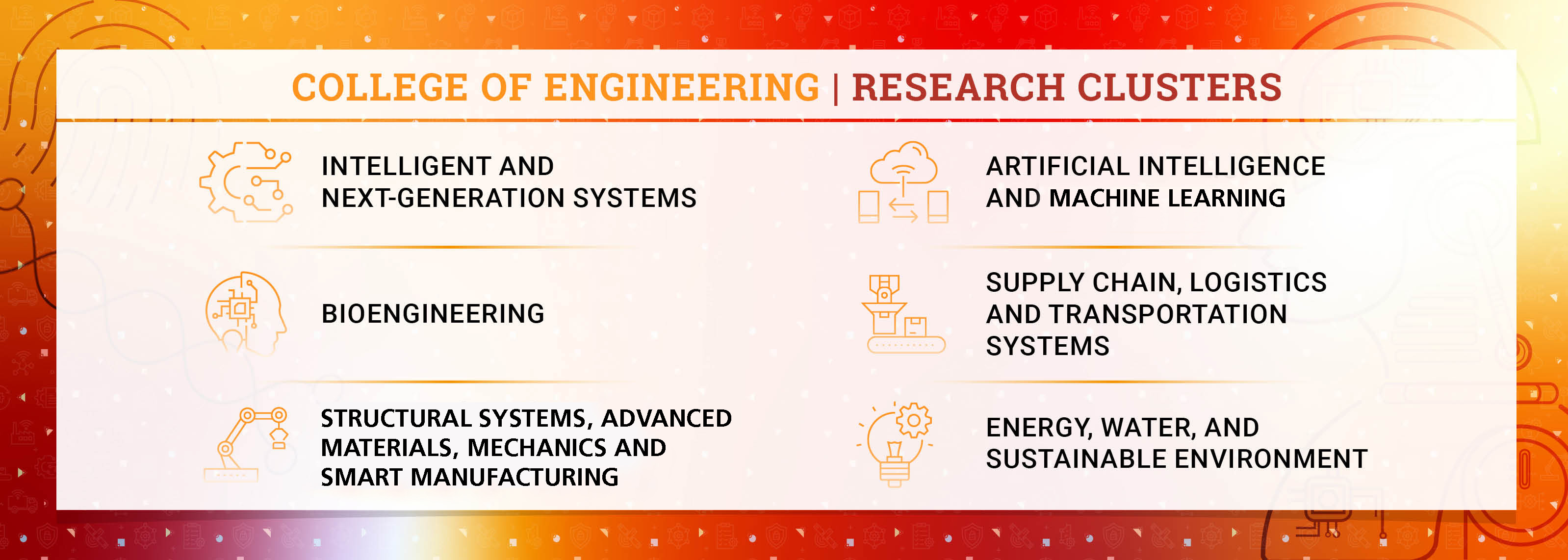
As part of our commitment to excellence, CEN has established six ground-breaking research clusters, each focusing on specific research themes closely aligned with the expertise of our esteemed faculty members. Ground-breaking ideas converge in these dynamic hubs, fostering collaborative efforts that drive pioneering solutions to real-world challenges.
By creating these research clusters, our aim is twofold: to showcase our areas of research strength within CEN and to forge impactful partnerships with industry collaborators and endowments, further enriching our research endeavors. These strategic collaborations will not only propel our institution's growth but also stimulate innovation and drive economic development.
Our research themes within these clusters not only reflect CEN's commitment to pushing boundaries but also align with the strategic national agendas of the United Arab Emirates. By addressing crucial societal and technological challenges, we contribute to the development and progress of the nation, while elevating our own research agenda and enhancing the visibility, ranking and branding of CEN on a global scale.
We invite you to explore these research clusters and learn more about the transformative work being conducted by our faculty members and students. Join us on this exciting journey as we continue to push the frontiers of engineering research, innovation and education.
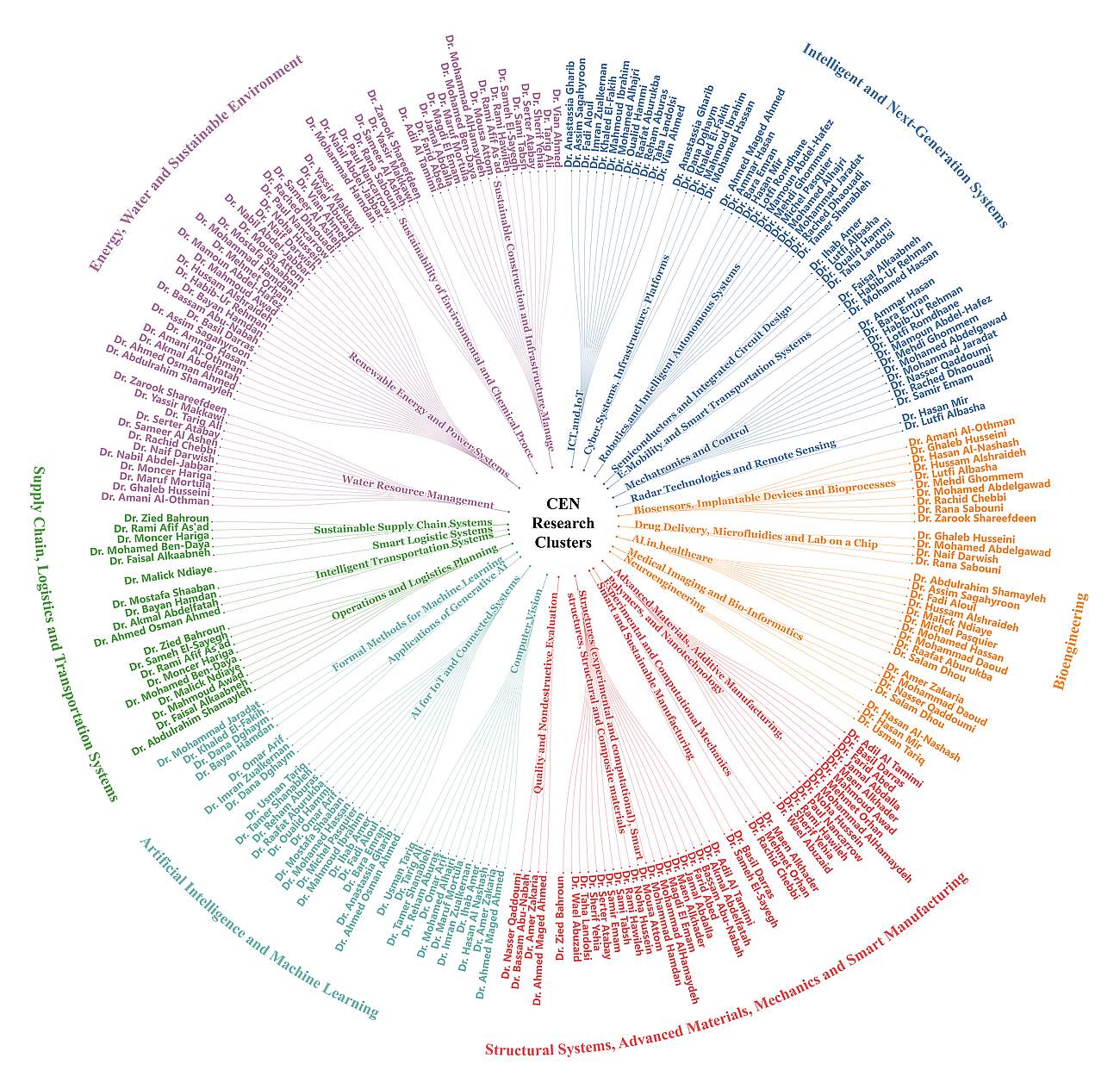
Clusters and Themes
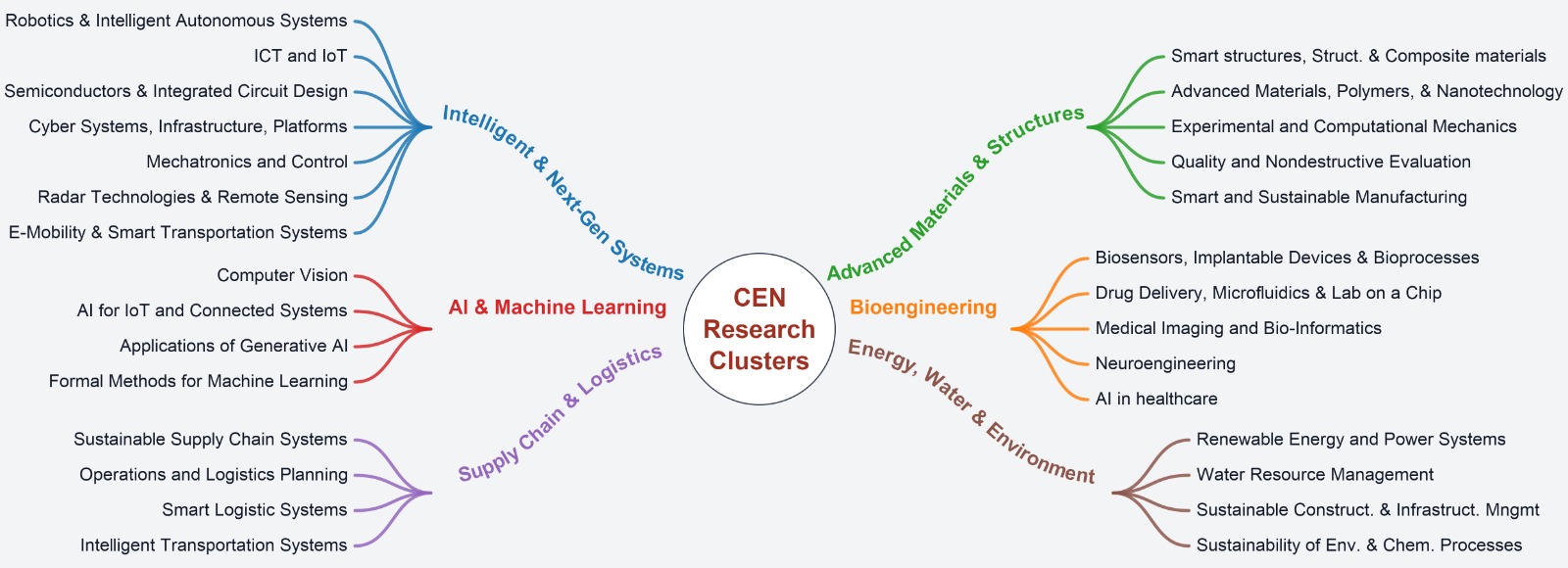
CEN Research Clusters: A Visual Overview (as of 2026)
- Cluster 1: Intelligent and Next-Generation Systems

Intelligent and next-generation systems is a multidisciplinary field that combines principles of engineering with decision-making systems to improve human life. Numerous research projects conducted by experienced AUS-CEN researchers cover this research theme. This field spans a wide range of areas including robotics, intelligent autonomous systems, unmanned air vehicles, computer vision, face biometrics, neuroengineering, sensors and connectivity, electronic chip design, flexible and wearable electronics, cyber physical systems, control of physical systems, sustainable and resilient operation and maintenance of civil infrastructures, networking, electronic warfare systems, communication systems, and satellite systems and applications. Due to the importance and nature of this theme to achieve the UAEs’ Sustainable Development Goals and with the large capacity of available well-reputed researchers, the college is looking forward to establishing an Endowed Chair in Intelligent and Next-Generation Systems.
- Theme 1-1: Robotics and Intelligent Autonomous Systems
This theme covers areas related to robotics, autonomous systems and drones (UAVs), including perception, sensing, navigation, path planning in robotics, intelligent robot control, intelligent robot systems and AI based learning in robotics.
- Theme 1-2: ICT and IoT
ICT Includes communication systems devices and applications for learning environments. IoT deals with designing and connecting devices and making them smart and autonomous.
- Theme 1-3: Semiconductors and Integrated Circuit Design
This theme includes the design of miniaturized and integrated electronic systems on chips, smart sensors, flexible electronics, nano carbon tubes as well as semiconductor material and modeling.
- Theme 1-4: Cyber Systems, Infrastructure, Platforms
This theme addresses areas related to infrastructure service provisioning, such as Cyber Physical Systems, Cyber Security, Cloud, Networking and Specialized Computing platforms like GPUs.
- Theme 1-5: Mechatronics and Control
This theme includes mechatronics system design, modern control and intelligent control, embedded and real time control, hardware in-loop control of physical systems involving integration to network services, intelligent mechatronic systems and AI based learning for mechatronic systems, and microelectromechanical systems (MEMS) modeling, design, and testing.
- Theme 1-6: Intelligent Civil Infrastructure
This theme includes intelligent (sustainable, resilient and smart) evaluation, operation and maintenance of civil infrastructures, including building, roads, traffic systems, pipelines, dams, water treatment plants, waste management and others.
- Theme 1-7: Radar Technologies and Remote Sensing
This theme addresses design and implementation of advanced radar systems for drone detection and imaging techniques for airport security.
- Theme 1-8: E-Mobility and Smart Transportation Systems
This theme covers areas related to electric mobility and vehicular technologies, including the design and optimization of electric and hybrid vehicles, battery management systems, power electronics, electric drivetrains, charging infrastructure, and vehicle-to-grid (V2G) integration. Research also covers vehicle-to-everything (V2X) communications, cooperative and autonomous driving, smart charging, energy storage, and AI-driven solutions for efficient, connected, and sustainable mobility.
- Cluster 2: Bioengineering

Bioengineering is a multidisciplinary field that combines principles of physics, chemistry and biology with engineering sciences to study and advance knowledge in biology, anatomy, physiology and human health. A bioengineer can develop diagnostic instruments, novel materials, drug delivery systems or informatics, to name a few examples. The main objective of the bioengineering field is to improve patients' quality of life and help advance health professions. This discipline is rapidly evolving throughout the world, with excellent employment opportunities. The American University of Sharjah College of Engineering has expertise in various areas of bioengineering, including biosensors, implantable devices, bioprocesses, drug delivery, microfluidics, medical imaging, signal processing, bio-informatics and neuroengineering. AUS research projects range from examining the severity of spinal cord injury to a patented technology aimed at reducing the side effects of chemotherapy. With this wide array of research and skills, the college is seeking to establish an Endowed Chair in Bioengineering.
- Theme 2-1: Biosensors, Implantable Devices and Bioprocesses
This theme focuses on flexible bioelectrode/biosensing materials, design, fabrication and materials in Medical Monitoring and Diagnosis.
- Theme 2-2: Drug Delivery, Microfluidics and Lab on a Chip
This theme includes metal organic networks, micelles, liposomes, targeted delivery, ultrasound, light, microwave power, Nanoparticle synthesis, mechanobiology, digital microfluidics.
- Theme 2-3: Medical Imaging and Bio-Informatics
This theme focuses on applications related to medicine and bio-informatics, medical imaging, integrate multimodal imaging data, design secure platforms for storing, sharing and analyzing clinical and bioinformatics data.
- Theme 2-4: Neuroengineering
This theme includes areas include mental stress management, cognitive vigilance assessment and enhancement, emotions monitoring, flexible implantable electrodes in peripheral nerve injury, cortical source imaging in epilepsy and severity assessment of spinal cord injury
- Theme 2-5: AI in healthcare
This theme addresses data analytics, health informatics, hospital management, healthcare quality improvement, machine learning for drug delivery applications, smart wearable technologies for real-time monitoring, Internet of Medical Things (IoMT) and application of smart wireless and low power semiconductor devices.
- Cluster 3: Structural Systems, Advanced Materials, Mechanics and Smart Manufacturing

The research efforts within the College of Engineering at AUS span across various areas related to materials, structures and manufacturing. About 25 faculty members from the different engineering departments conduct cutting-edge research under this cluster with significant productivity in terms of publications in international journals and graduating students with significant expertise in these relevant engineering and scientific fields. Industry-relevant and practical research projects include the development of polymers and composite materials, 3D printing, advanced manufacturing, engineering structures and structural materials, advanced and functional smart materials, and non-destructive assessment and structural health monitoring. With this wide array of research and skills, the college is seeking to establish an endowed chair for this research cluster.
- Theme 3-1: Structures (experimental and computational), Smart structures, Structural and Composite materials
This theme encompasses structural systems that integrate experimental, computational, smart, and composite approaches. It combines physical testing with advanced simulations to analyze and optimize load-bearing performance, while supporting the design and implementation of sensor-enabled, adaptive structures for real-time health monitoring and active control. It also advances the development of high-strength, lightweight composite materials engineered for enhanced durability, damage tolerance, and multifunctional capabilities. Research areas include structural mechanics, smart and responsive materials, and innovative systems for resilient infrastructure.
- Theme 3-2: Advanced Materials, Additive Manufacturing, Polymers, and Nanotechnology
This theme focuses on next-generation functional materials, 3D/4D concrete printing, 3D metal and polymer printing, design of tailored properties through layer-by-layer fabrication for complex and efficient production. It leverages advanced polymer chemistries and nanoscale control to enable lightweight, high-performance applications. Research areas include development of polymers and composite materials, additive manufacturing, and nanoscale engineering to enhance mechanical, thermal, electrical, and environmental performance.
- Theme 3-3: Experimental and Computational Mechanics
This theme focuses on experimental and computational mechanics, integrating hands-on testing and measurement with advanced numerical modeling to understand, predict, and optimize the behavior of structures and materials under load. It emphasizes the use of diverse measurement techniques and simulation tools to validate models and address practical engineering challenges. Research areas include fracture mechanics, dynamic loading, and the integration of laboratory testing with methods such as finite element analysis and multiscale simulations.
- Theme 3-4: Quality and Nondestructive Evaluation
This theme focuses on quality assurance, nondestructive evaluation (NDE) and structural health monitoring (SHM) to assess the integrity, reliability and safety of materials and structures. It employs advanced diagnostic and sensing techniques to detect and characterize defects to evaluate performance, optimize maintenance strategies, and support design validation and lifecycle management.
- Theme 3-5: Smart and Sustainable Manufacturing
This theme focuses on smart and sustainable manufacturing by integrating digital technologies such as sensors, IoT, data analytics, and AI with lean, low-impact production practices. It aims to optimize resource and energy use, minimize waste through circular economy strategies, and enhance product lifecycle performance. The approach supports resilient, adaptable supply chains that align with economic, environmental, and social sustainability goals. Research areas include digital twins, energy-efficient processes, green materials, and sustainable supply chain design.
- Cluster 4: Artificial Intelligence and Machine Learning

The Artificial Intelligence and Machine Learning cluster focuses on creating intelligent, data-driven method and techniques to address real-world challenges across a wide range of domains. Faculty at AUS advance both the development and application of AI in diverse areas. Research covers themes such as computer vision for image and video analysis, AI for the Internet of Things and connected systems with an emphasis on real-time, secure, and energy-efficient solutions, and generative AI for language, software, and educational content. The cluster also explores formal methods to ensure that machine learning systems are reliable, correct, and verifiable. By blending innovative research with real-world applications, the cluster aims to build AI systems that are powerful, adaptable, and designed to have a positive impact on society. The College of Engineering at AUS seeks to establish an Endowed Chair in AI to foster high-quality research and development across a wide range of AI applications.
- Theme 4-1: Computer Vision
This theme focuses on developing algorithms for image and video analysis, covering areas such as visual recognition, foundation models for vision, zero-shot and multi-label learning, remote and geospatial imaging for environmental monitoring, human activity recognition, video streaming optimization, classroom observation and engagement, and real-time vision applications on mobile and edge devices.
- Theme 4-2: AI for IoT and Connected Systems
This theme focuses on applying AI to IoT and connected systems, emphasizing real-time intelligence at the edge. Key areas include AI for secure systems, high-performance and energy-efficient edge and fog AI computing, and intelligent, interconnected environments.
- Theme 4-3: Applications of Generative AI
This theme covers the applications of generative AI in language, software, and educational content generation, with key areas including NLP for Arabic, LLMs for software engineering, and AI-driven learning content.
- Theme 4-4: Formal Methods for Machine Learning
This theme focuses on applying formal methods to machine learning to ensure the reliability, correctness, and verifiability of AI systems, with key areas including formal methods for ML test case generation and the use of LLMs to address formal system problems.
- Cluster 5: Supply Chain, Logistics and Transportation Systems

The UAE 2021–2030 roadmap initiatives present new opportunities to enhance the efficiency, sustainability, and resilience of supply chain and transportation systems. These national strategies aim to cut transportation costs by 44%, reduce environmental pollution by 12%, and generate AED 18 billion in annual economic returns through improvements in logistics and mobility infrastructure.
With the rapid adoption of emerging technologies, such as artificial intelligence (AI), autonomous vehicles, data analytics, and blockchain, the supply chain industry is undergoing a major transformation. These advancements enable organizations to optimize operations, improve decision-making, and reduce environmental impact, while aligning with global sustainability and smart city goals.
- Theme 5-1: Sustainable Supply Chain Systems
This theme focuses on developing environmentally responsible and resource-efficient logistics networks. Topics include green supply chains, reverse and closed-loop logistics, carbon footprint reduction, cold chain sustainability, and circular economy integration.
- Theme 5-2: Operations and Logistics Planning
This theme addresses the design and optimization of logistics and supply chain operations, including inventory management, warehousing, vehicle routing and scheduling, distribution network design, and resource allocation under uncertainty.
- Theme 5-3: Smart Logistic Systems
This theme explores the integration of emerging technologies—such as drones, blockchain, Internet of Things (IoT), and Industry 4.0 solutions—to enhance real-time visibility, traceability, and automation across supply chain processes.
- Theme 5-4: Intelligent Transportation Systems
This theme investigates the application of artificial intelligence, machine learning, and data-driven decision support in transportation and mobility systems. Areas of interest include optimization of traffic operations, transportation planning, transportation electrification, public transportation systems planning scheduling and operations, predictive demand forecasting, autonomous fleet management, intelligent traffic control, energy-efficient routing for electric vehicles, and AI-driven logistics optimization for smart cities.
- Cluster 6: Energy, Water and Sustainable Environment

The College of Engineering at the American University of Sharjah (AUS) is a regional leader in research and innovation addressing global challenges in energy, water, and environmental sustainability. Faculty members across multiple disciplines have established advanced laboratory facilities and collaborative platforms to support cutting-edge research in these fields. Their collective efforts focus on developing viable, efficient, and sustainable technological solutions; many of which are disseminated through high-impact international journals and conferences. This cluster brings together faculty expertise in energy systems, water resource management, environmental technologies, and sustainable infrastructure, aiming to foster multidisciplinary approaches toward a more resilient and resource-efficient future.
- Theme 6-1: Renewable Energy and Power Systems
This theme focuses on the development, integration, and optimization of advanced and sustainable energy technologies. Research areas include smart grids, distributed energy resources, microgrids, cyber-physical energy systems, AI-driven monitoring and control, and energy analytics. It also encompasses hydrogen production and storage, bioenergy, energy harvesting, and electric vehicle technologies, with emphasis on renewable conversion systems such as solar PV, wind energy, and fuel cells. It addresses polymeric materials for energy applications, process design, and multi-energy systems to enhance efficiency and reliability in future energy networks.
- Theme 6-2: Water Resource Management
This theme addresses sustainable management, purification, and distribution of water resources through advanced scientific and engineering approaches. Research areas include water quality monitoring, environmental hydraulics and hydrology, wastewater treatment, and pollutant removal technologies. Specific efforts focus on membrane-based separation, desalination, and hydraulic network optimization. It includes modeling and experimental studies on coastal flood resilience, groundwater contamination, and urban water systems, contributing to improved water security and environmental protection.
- Theme 6-3: Sustainable Construction and Infrastructure Management
This theme focuses on integrating sustainability principles into the design, construction, and operation of infrastructure systems. Research areas include green construction materials, life-cycle assessment, resource efficiency, and resilient infrastructure development. It covers sustainable project management, recycled material utilization, and certified green building frameworks, aiming to reduce environmental impacts while improving performance and economic viability.
- Theme 6-4: Sustainability of Environmental and Chemical Processes
This theme explores methods to enhance sustainability in industrial and chemical processes while minimizing waste and emissions. Key research areas include carbon capture using metal-organic frameworks (MOFs), green corrosion inhibitors, ionic liquids in separations and reaction systems, edible films and coatings, and waste-to-energy conversion technologies. The theme also emphasizes pollution prevention, air quality control, and waste valorization, aligning with global efforts to create circular, low-carbon industrial ecosystems.